Destello, the Whole Fly Nervous System Working Through Its Two Real Eyes
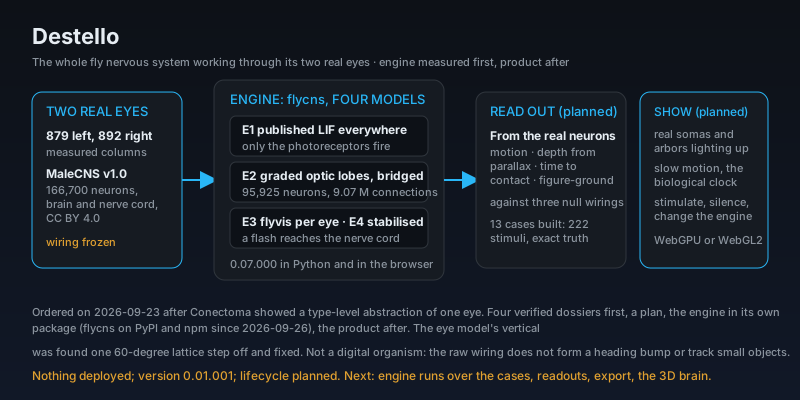
The male fruit fly's whole nervous system, working, seen through its two eyes: the MaleCNS v1.0 connectome (166,700 neurons, brain and nerve cord, CC BY 4.0) driven through both real compound eyes (879 left and 892 right measured columns) and run with the published neuron models, a graded optic lobe and a leaky integrate-and-fire model elsewhere, so a visitor can watch real neurons fire as real soma positions and real arbors lighting up, from the photoreceptors to the descending neurons and the nerve cord, in slow motion with the biological clock on screen, and intervene. The science: which visual computations and behaviours the measured wiring produces on its own, against three null wirings, and whether depth and fast segmentation can be read from the real neurons whose job it is. State: the engine, flycns, is complete in Python (0.06.000) and measured on the real connectome; the web product is not built and nothing is deployed. Lifecycle: planned.
Business Context
For a visitor the promise is to watch a real nervous system work, not a cartoon of one: every soma at its measured position, every arbor lighting as it fires, the biological clock on screen, and the ability to stimulate or silence a neuron or a type, change the stimulus or change the engine. For a researcher the value is the same measurement discipline as its predecessor, with the whole measured wiring instead of a type-level abstraction: which computations the wiring produces on its own against three nulls. What the product will not be is written down before it exists: not a digital organism and not a complete behavioural model; the connectome is frozen and only readouts learn; the body is a kinematic readout display.
Strategic Value
Destello is the honest successor of a product its owner judged to have missed the point, built in the mandatory order: four verified dossiers first, a plan, the engine extracted to its own package under the package rule because compiling and simulating a connectome is domain-agnostic, and only then the product. The engine is published as flycns on PyPI and as @fasl-work/flycns on npm (0.7.0, 2026-09-26; the npm package waited for the browser engine rather than ship empty), and Destello's pipeline consumes the PyPI release. Nothing is deployed and this card says so; the next units are the engine runs over the case matrix, the readouts, the export and the web product with the 3D brain.
The Challenge
Conectoma showed a type-level abstraction of one eye rather than the real connectome working; its owner ordered a successor on 2026-09-23 that drives the whole measured nervous system, neuron by neuron, through both real compound eyes, with the published neuron models and nothing learned inside the wiring. The community's connectome projects were read and their demos opened, the primary sources checked on Crossref, Europe PMC, the official download page and the code, and the rendering, simulation and payload costs measured before a line of the product was written. The raw wiring under these models is known not to form a heading bump, turn toward objects or track small objects, so an honest product has to show those as open, with their named reason, rather than as features.
Our Approach
The engine is flycns, its own repository and package: it compiles fly connectome releases (MaleCNS v1.0 first) into simulation-ready signed graphs with positions and per-eye column maps, models the two compound eyes, and simulates the whole central nervous system in Python (NumPy and PyTorch) and, since 0.07.000, in the browser, in TypeScript on the CPU and in WGSL on WebGPU: the CPU engine reproduces the Python reference spike for spike, the whole CNS included, and the WebGPU engine fires the same neurons the same number of times. Version 0.06.000 coupled the whole CNS in the plan's four engines, each measured on MaleCNS: the published leaky integrate-and-fire model everywhere (photoreceptors fire and nothing else does, because histaminergic inhibition of silent spiking neurons carries nothing); flyvis's trained numbers on the MaleCNS optic lobes (95,925 neurons, 9.07 million connections, 4,873 stand-in photoreceptors) coupled to the spiking model through a bridge and feedback; flyvis's own network per eye mapped onto MaleCNS; and the hybrid with stabilisers. A flash reaches the nerve-cord motor neurons through the second to fourth engines. Building the engine exposed the eye model's vertical one 60-degree lattice step off, which T4 tuning revealed and the dorsal rim now sets. Destello 0.01.000 built the visual world: an analytic renderer of what each ommatidium of both eyes sees (19 rays over its acceptance), with the exact truth per ommatidium and frame (depth, object, optic flow, time to contact), and the thirteen cases with their 222 stimuli, split by scene layout. The plan still holds three null wirings, readouts for motion, depth from parallax, time to contact and figure-ground (two of them learned), a three.js scene on WebGPU with the WebGL2 fallback, and a deployment decided by the measured export: GitHub Pages if it fits, else the ML VPS.
Key Performance Indicators
| KPI | Baseline | Result | Impact |
|---|---|---|---|
| The real connectome, not an abstraction of it | A type-level model of one eye (Conectoma) | 166,700 neurons of brain and nerve cord driven through 879 left and 892 right real columns, with the published neuron models and nothing learned inside the wiring | What the wiring does on its own becomes measurable |
| An engine measured before a product exists | A simulator promised with the app | flycns 0.07.000: four engines coupled on MaleCNS, the optic lobes held to flyvis itself, a flash reaching the nerve-cord motor neurons, and a browser engine that reproduces the Python reference spike for spike; the eye model's vertical found one lattice step off and fixed | The web product will replay a measured engine |
| Open questions shown as open | Behaviours implied by the demo | The raw wiring under these models does not form a heading bump, turn toward objects or track small objects; the plan shows those as open with their named reason | Not a digital organism, and it says so |
Architecture
destello pipeline
Technology Stack
Visual assets for this project are not publicly available.