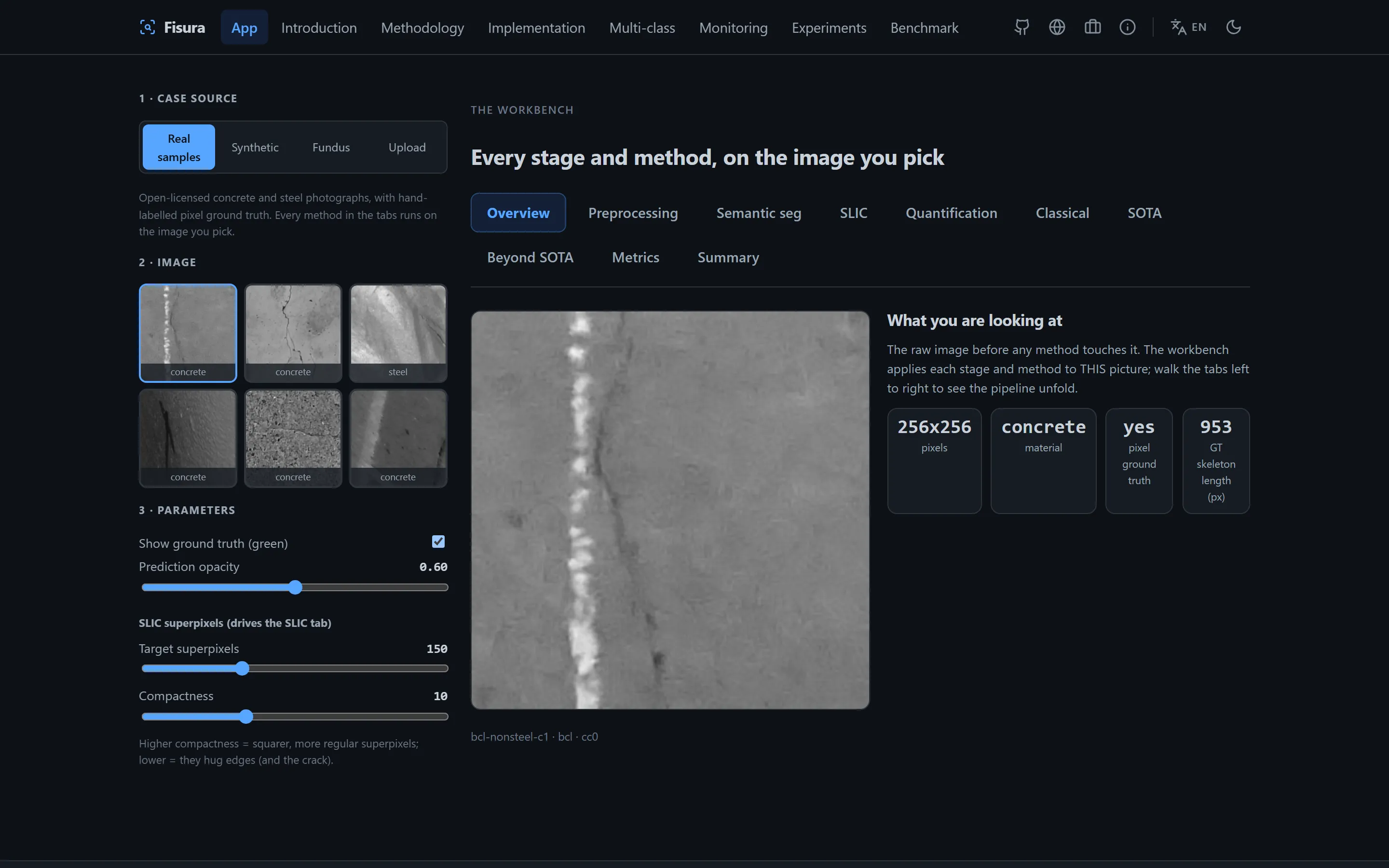
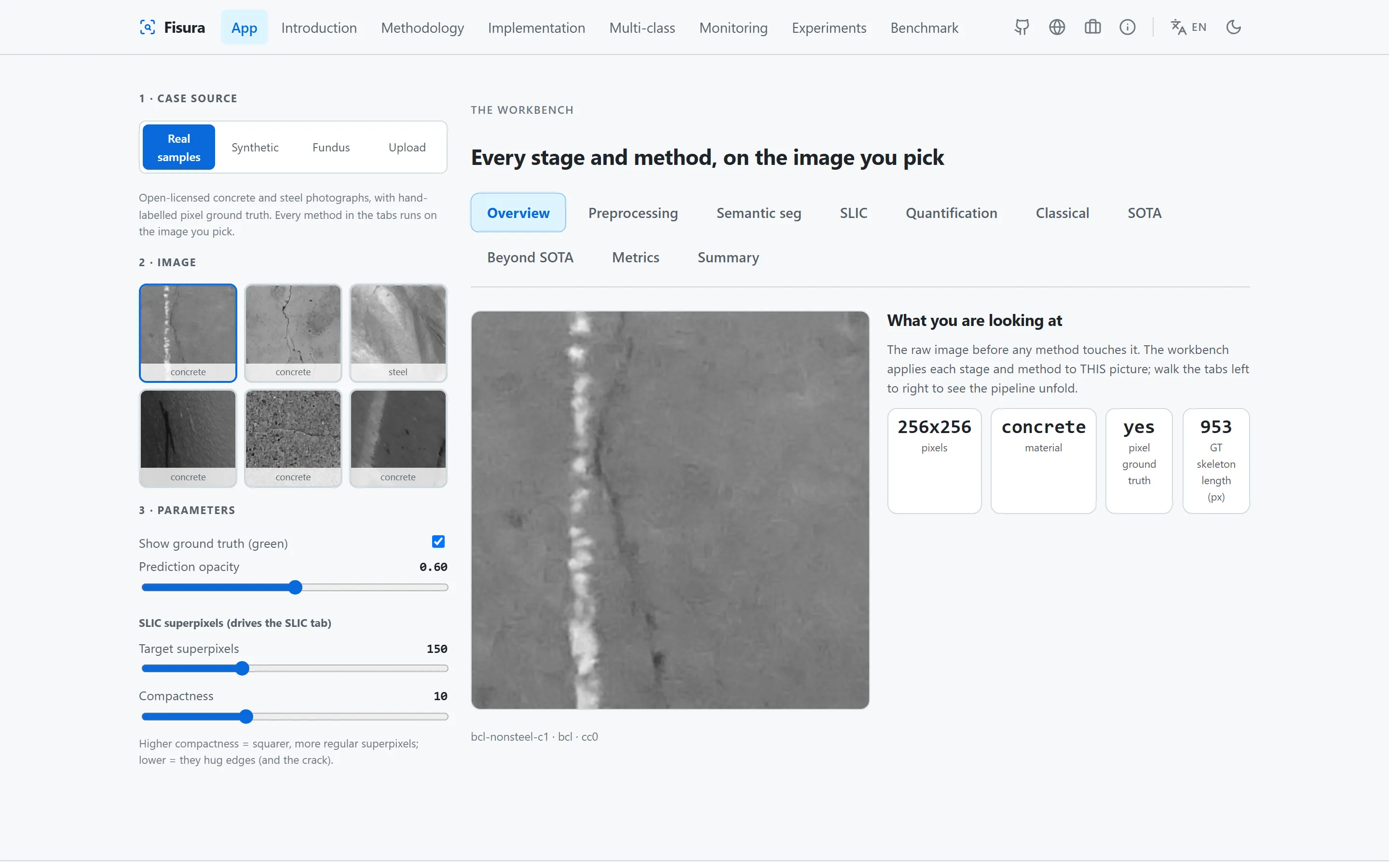
Fisura, Materials-Damage Vision Lab (Crack Detection to Engineering Units)
A public research lab on seeing damage in built materials. One image of a concrete wall, pavement, masonry facade or industrial surface goes in; Fisura detects the damage (cracks, spalling, surface defects), quantifies it in engineering units (width, length, orientation, density, growth between inspections), and shows how every method family gets there on the same open cases with the same metrics. The ladder runs classical pipelines, learned SOTA segmentation, promptable foundation models and unsupervised anomaly detection, then measurement (pixel-to-mm calibrated width/length, change detection, 2D digital image correlation). Masks are never the end result: they are the input to engineering numbers. Offline heavy lane plus a browser live lane where the photo never leaves the device. Scope: it is a method-comparison lab, not a certified inspection tool, and the classical engine is real while the higher tiers land one vertical slice at a time.
Business Context
Structural inspection at scale (bridges, dams, pavements, building facades, industrial plant) is expensive and inconsistent when done by eye. The value of a vision tool here is not a prettier mask, it is a defensible measurement: a crack width in millimetres, a growth rate between inspections, and a clear statement of which method produced it and how it was calibrated. Fisura is built as a same-case comparison across the whole method zoo, so an engineer can see where classical morphology is enough, where learned segmentation earns its cost, and where a foundation model actually helps, instead of trusting one vendor benchmark.
Strategic Value
Fisura demonstrates a full classical-to-foundation method ladder for materials-damage vision, compared on shared open cases, with the discipline that a mask is only ever an input to a calibrated engineering number, not the deliverable. It runs the heavy comparison offline and replays audited artifacts, plus a privacy-preserving in-browser live lane. It is a reusable pattern for comparing computer-vision methods in inspection on equal terms: same cases, same metrics, accuracy and measurement reported separately, with the full data kept outside the repo and the whole thing reproducible. It is under active build-out, one vertical slice (code, tests, deep docs) at a time, and the app says so.
The Challenge
Damage inspection of concrete, pavement and masonry is mostly visual and mostly manual, and the useful question is not "is there a crack" but "how wide, how long, how oriented, and has it grown since last time". Computer-vision papers stop at a segmentation mask and a benchmark score; an inspector needs a number in millimetres with a stated method and a stated uncertainty. And the field is a zoo of method families (classical morphology, learned segmentation, foundation models, anomaly detection) that are almost never compared on the same footing, so it is hard to know what actually earns its place.
Our Approach
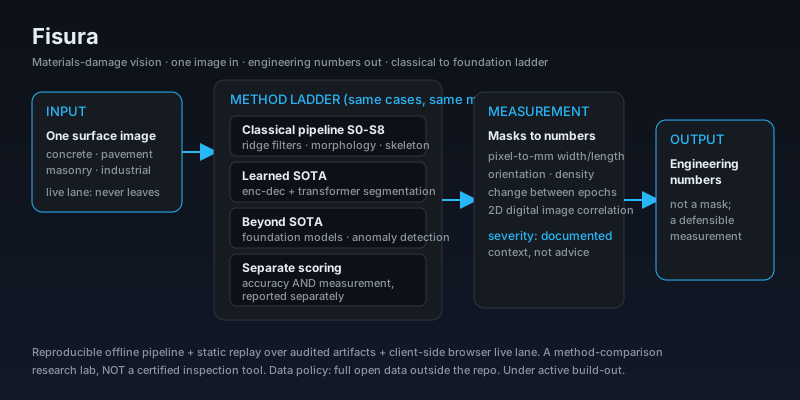
Fisura runs one image through a full method ladder and reports each family on the same open cases with the same metrics. The classical engine is a staged S0 to S8 pipeline (illumination correction, adaptive thresholding, Hessian ridge filters, morphological path operators, minimal-path linking, skeleton geometry) with a documented L0 to L5 ladder and dual-tolerance evaluation. Above it, learned SOTA (encoder-decoder and transformer crack segmentation, patch classification, multi-class structural-damage models trained on open datasets), then beyond-SOTA (promptable foundation models and unsupervised industrial anomaly detection applied to surfaces). The measurement layer turns masks into engineering numbers: pixel-to-mm calibrated crack width and length, severity context from published guidance, change detection across inspection epochs, and 2D digital image correlation for vision-based deformation on specimen sequences. It ships as a reproducible offline pipeline (the heavy lane, artifacts plus manifests), a static replay web app over committed audited artifacts, and a browser live lane where a user photo is analysed client-side with the classical pipeline plus compact ONNX models, so no image leaves the browser. Full open datasets live outside the repo and are fetched by scripts; the repo commits only tiny contract-passing samples and license-checked compact artifacts.
Key Performance Indicators
| KPI | Baseline | Result | Impact |
|---|---|---|---|
| The deliverable | A segmentation mask and a benchmark score | Engineering numbers: pixel-to-mm calibrated crack width and length, orientation, density, and growth between inspection epochs | A defensible measurement an inspector can use, not just a mask |
| Method comparison | One vendor benchmark on one method | Classical, learned SOTA, foundation models and anomaly detection on the same open cases with the same metrics | You see what actually earns its place across the whole ladder |
| Privacy | Upload the inspection photo to a server | Browser live lane: classical pipeline plus compact ONNX, the photo never leaves the device | Client-side analysis, private by construction |
Architecture
fisura pipeline
Technology Stack
Reel
A short, composed reel of the product.
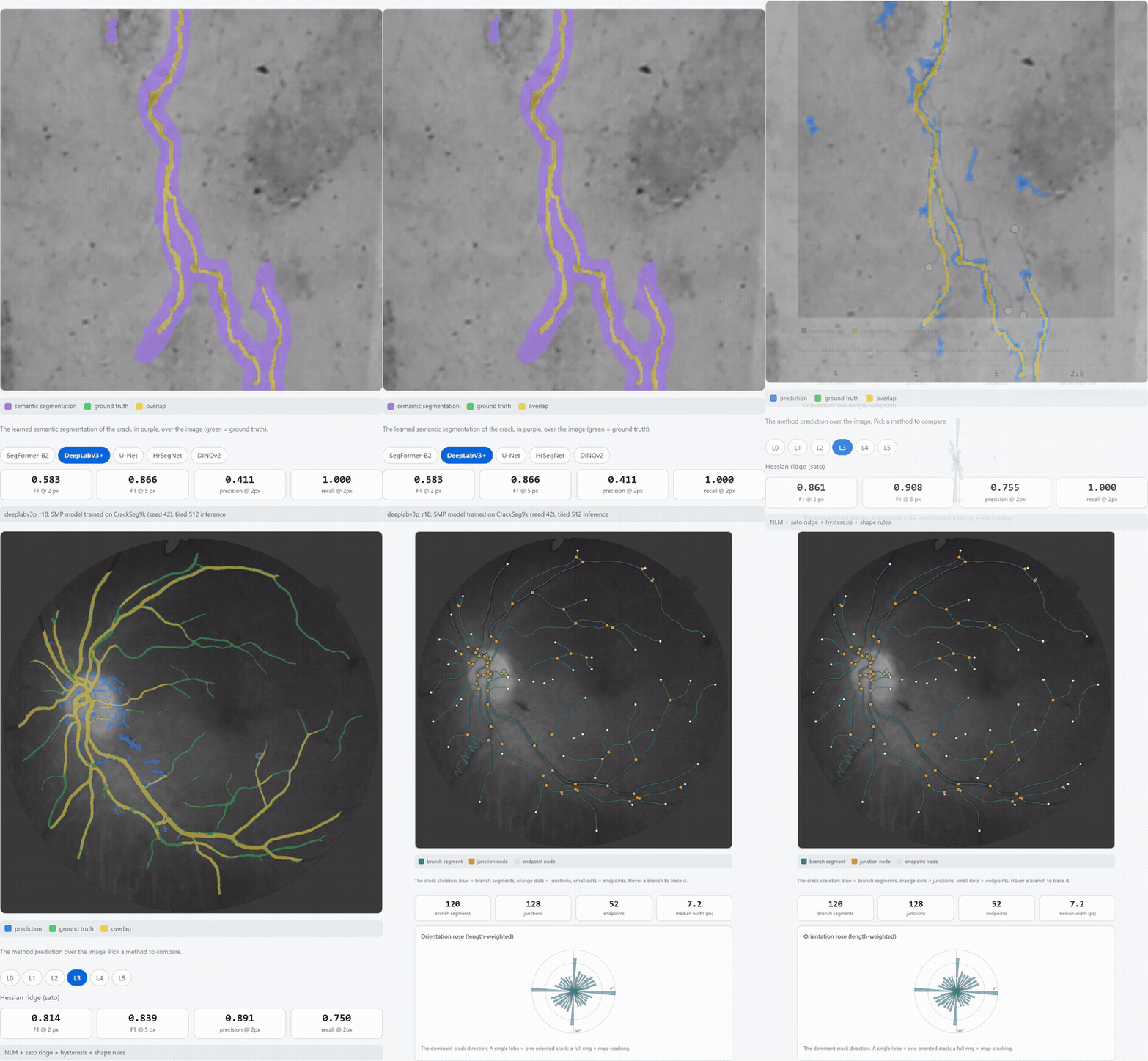
In action
A short tour of the live app: the real interface, recorded from the deployed site.

Application Screenshots