Fragua, Ensembles of Phenomenological Models for Mining and Industrial Processes
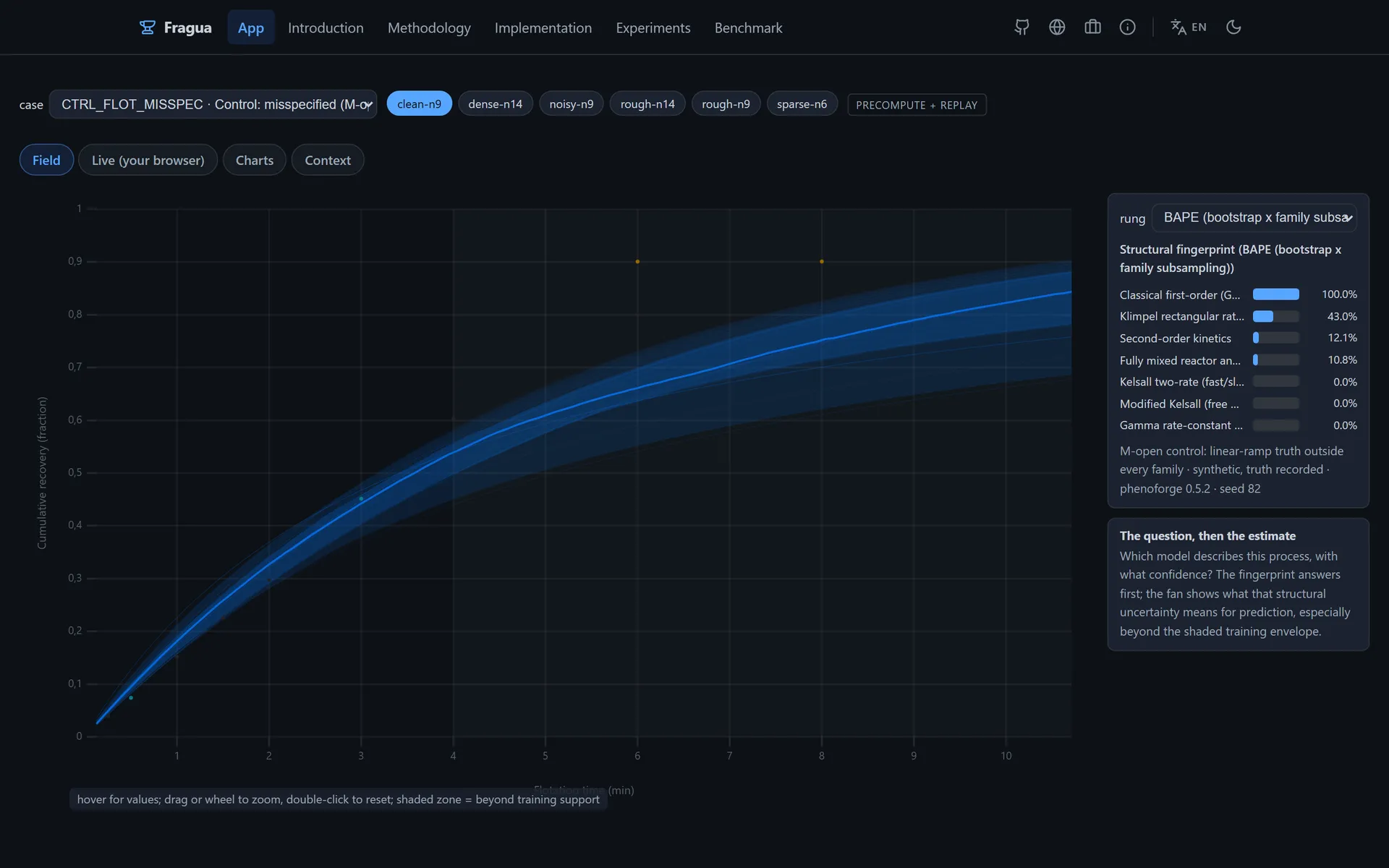
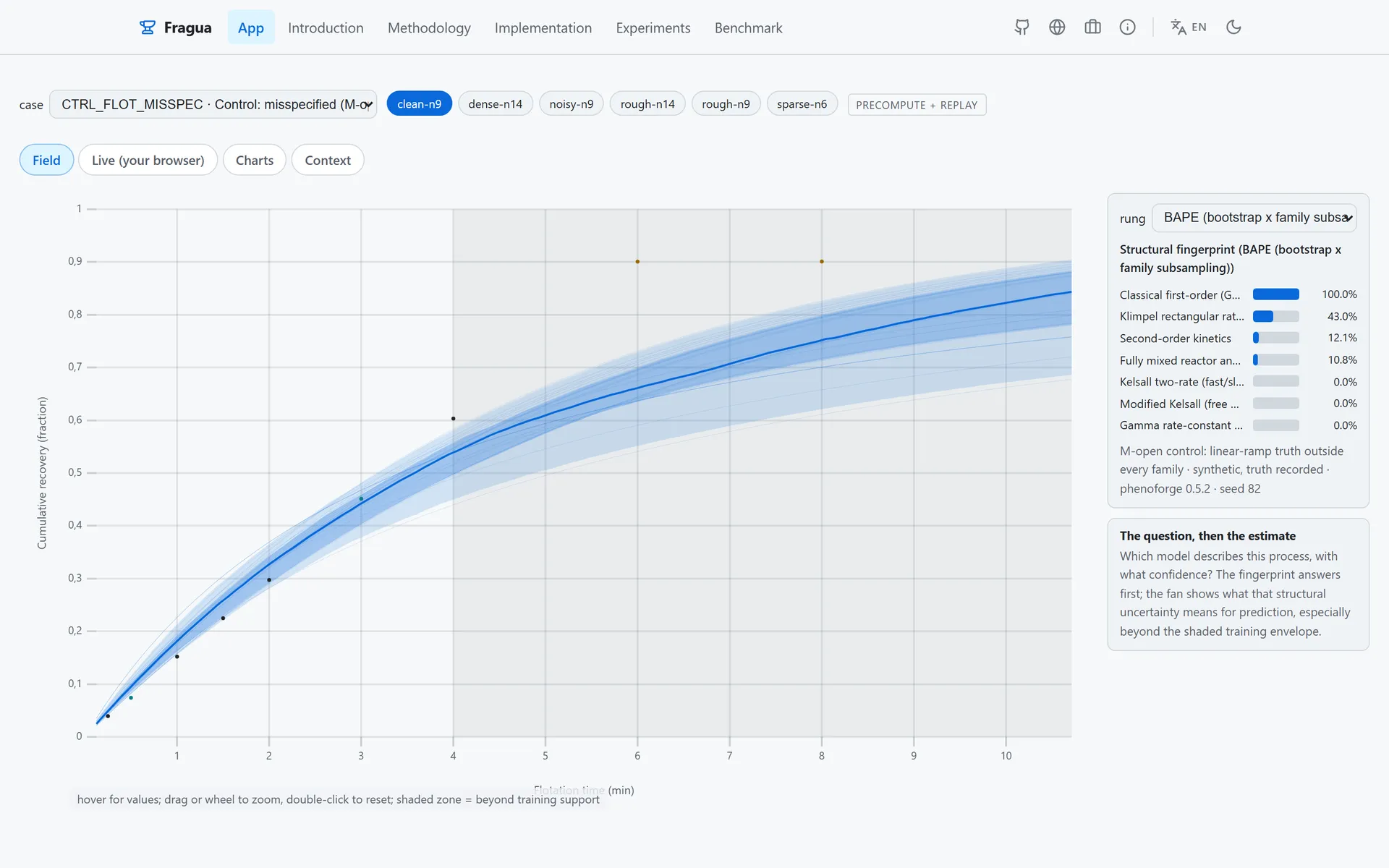
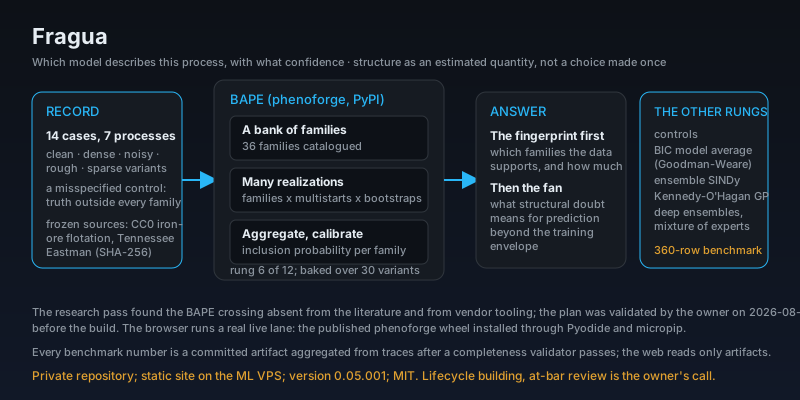
Instead of selecting one kinetic equation per unit process, Fragua fits many realizations, model families times parameter multistarts times bootstrap resamples, from a curated bank of phenomenological families, and aggregates them into calibrated ensemble models with structural inclusion probabilities: which model describes this process, with what confidence, and what that structural uncertainty means for prediction beyond the training envelope. The coined method, BAPE (Bootstrap-Aggregated Phenomenological Ensembles), is rung 6 of a twelve-rung measured ladder that also carries controls, a Bayesian model average, sparse discovery, a Kennedy-O'Hagan hybrid and deep ensembles, baked canonically over 30 variants; the browser runs a live lane through the published phenoforge wheel. A private research product with the concept's novelty gap verified against literature and vendors. Lifecycle: building.
Business Context
For a process engineer the deliverable is the question answered in the order it should be: which model describes this process and with what confidence, then the estimate with a band that reflects structural doubt rather than parameter noise alone. The misspecified control exists to show what the fingerprint does when no family is right. The plan was validated by its owner on 2026-08-25 before the build, the four dossiers are persisted, and the at-bar review of the shipped product is his call; the lifecycle stays building and no adoption is claimed.
Strategic Value
Fragua is a research product with its own coined method and a package boundary that holds: phenoforge is public on PyPI from its own repository, the product declares none. Its CI had a workflow whose triggers had never registered, found and fixed on 2026-09-18 (0.05.001); the live-content check after the first deploy caught a residue title and a stale engine version, both fixed the same day. Its sibling Porvenir learns latent dynamics from data where Fragua fits and ensembles closed-form equations: same industry, different object, different engine.
The Challenge
A flotation cell, a leach tank or a grinding circuit is usually modelled by picking one kinetic equation from a textbook and fitting its parameters, and the choice of equation, made once, carries more uncertainty than the parameters ever will. The physics-informed alternative fixes one residual and inherits the same problem. The question Fragua asks is structural: over a bank of published phenomenological families, which ones does the data support, with what probability, and how wide is the prediction band once that structural doubt is carried instead of hidden. The research pass found the concept absent from the literature and from vendor tooling, and that verified gap is the reason the product exists.
Our Approach
The engine is phenoforge, a separately published package (PyPI, MIT) from its own repository: the family bank, the multistart fitting, the bootstrap aggregation and the samplers. Fragua is the product on the CAOS archetype under the full scientific contract: a 14-case matrix over seven unit processes with clean, dense, noisy, rough and sparse variants, a misspecified control whose truth lies outside every family, and a twelve-rung ladder baked canonically over 30 variants: controls, the ensemble core with BAPE at rung 6, a BIC-weighted Bayesian model average through a Goodman-Weare sampler, ensemble SINDy with seeded bagging and blow-up-bounded integration, a Kennedy-O'Hagan Gaussian-process hybrid, and a learned tier of deep ensembles and a mixture of phenomenological experts on deterministic torch. The workbench shows the fan of realizations, the structural fingerprint per family, calibration and family cards, and a real live lane that installs the published phenoforge wheel in the browser through Pyodide and micropip. Every benchmark number ships as a committed artifact aggregated from traces after a completeness validator passes; the web reads only artifacts. The data vault holds SHA-256-frozen sources including the CC0 iron-ore flotation plant table and the Tennessee Eastman archive.
Key Performance Indicators
| KPI | Baseline | Result | Impact |
|---|---|---|---|
| Structure as an estimated quantity | One kinetic equation chosen once, its parameters fitted | Families times multistarts times bootstrap resamples aggregated into a calibrated ensemble with structural inclusion probabilities per family | The model choice carries its uncertainty into the prediction band |
| A control that no family can fit | Cases where some family is always right | A misspecified control with a linear-ramp truth outside every family, so the fingerprint can be seen behaving when the bank is wrong | The method is shown failing where it should |
| A ladder, not a single method | BAPE alone | Twelve rungs baked over 30 variants: controls, the ensemble core, a Bayesian model average, ensemble SINDy, a Kennedy-O'Hagan hybrid, deep ensembles and a mixture of experts; a 360-row benchmark artifact | BAPE is compared against the discovery and hybrid alternatives |
Proprietary, source code not publicly available
Architecture
fragua pipeline
Technology Stack
Application Screenshots