HyClus Viz, Hyperspectral Clustering Visualization
Deep autoencoders combined with t-SNE for transforming raw hyperspectral data into interpretable visualizations. Achieved 95-97% accuracy for grain size classification from mining comminution feeders.
Business Context
Hyperspectral imaging captures hundreds of spectral bands per pixel, data points living in hundreds of dimensions. The challenge for mineral identification is compressing this into representations that humans can interpret without losing the mineralogically meaningful spectral structure. Linear methods like PCA miss nonlinear relationships in spectral data, and simply selecting a few bands discards potentially critical information.
Strategic Value
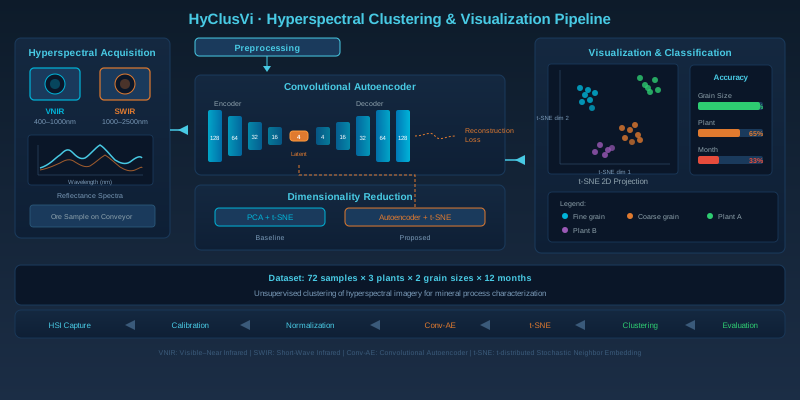
A symmetric deep autoencoder (input→128→64→32→16→4 bottleneck→decoder) compresses hundreds of spectral bands into a 4-dimensional representation that preserves mineralogically meaningful structure. Combined with t-SNE for nonlinear 2D visualization and K-means clustering, the system achieved 95-97% accuracy for grain size classification on real mining data (72 monthly composites from 3 plants). Plant origin (57-65%) and temporal patterns (24-33%) proved harder to distinguish, itself a useful finding suggesting process homogeneity across sites.
The Challenge
Hyperspectral imaging captures hundreds of spectral bands per pixel. Compressing this high-dimensional data into compact, interpretable representations for mineral identification requires nonlinear dimensionality reduction that preserves meaningful spectral structure.
Our Approach
Symmetric deep autoencoder (input→128→64→32→16→4 bottleneck→decoder) with tanh activation for spectral compression, followed by t-SNE for 2D embedding and K-means clustering with elbow method. Evaluated on real mining data: 72 monthly composites across 3 plants, 2 granulometry levels, 12 months.
Key Performance Indicators
| KPI | Baseline | Result | Impact |
|---|---|---|---|
| Grain Size Classification | Manual spectral analysis | 95-97% accuracy | Automated grain characterization |
| Dimensionality | Hundreds of spectral bands | 4-dimensional bottleneck | Interpretable compact representation |
Proprietary, source code not publicly available
Architecture
hyclusvi pipeline
The Dimensionality Problem
A hyperspectral camera captures hundreds of spectral bands per pixel, a data point living in hundreds of dimensions. The challenge: compress this into something a human can interpret without losing the mineralogically meaningful structure. Linear methods (PCA) miss the nonlinear relationships in spectral data. Simply picking a few bands throws away information that might matter.
Deep Compression
A symmetric deep autoencoder (Input → 128 → 64 → 32 → 16 → 4 → 16 → 32 → 64 → 128 → Output) with tanh activation compresses hundreds of spectral bands into a 4-dimensional bottleneck representation. The network learns to discard noise and redundancy while preserving the spectral features that distinguish different mineral compositions.
After compression, t-SNE provides a nonlinear 2D embedding for visualization, preserving local neighborhood structure so spectrally similar samples remain close in the map. K-means clustering with the elbow method identifies natural groupings.
What the Data Reveals
Evaluated on real mining data: 72 monthly composites from 3 processing plants, 2 granulometry levels, 12 months:
| Task | Accuracy |
|---|---|
| Grain size classification | 95–97% |
| Plant origin | 57–65% |
| Month prediction | 24–33% |
The grain size result is striking: spectral data encodes meaningful physical properties related to particle size with near-perfect classification accuracy. Plant origin and temporal patterns are harder to distinguish, which is itself a useful finding, suggesting relatively homogeneous processing across sites and stable spectral signatures over time.
Technology Stack
Visual assets for this project are not publicly available.
This is a proprietary project. Source code and external resources are not publicly available.