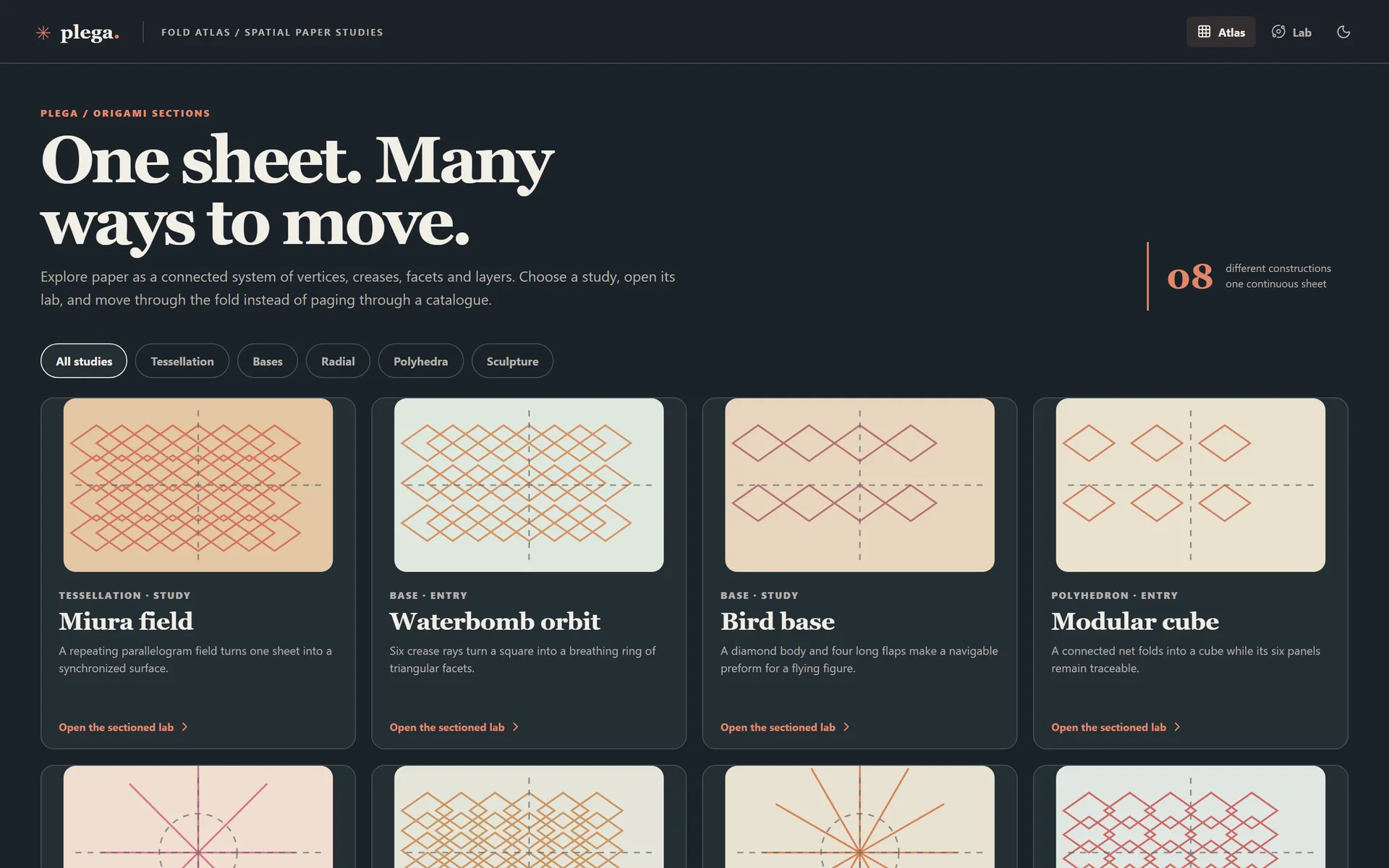
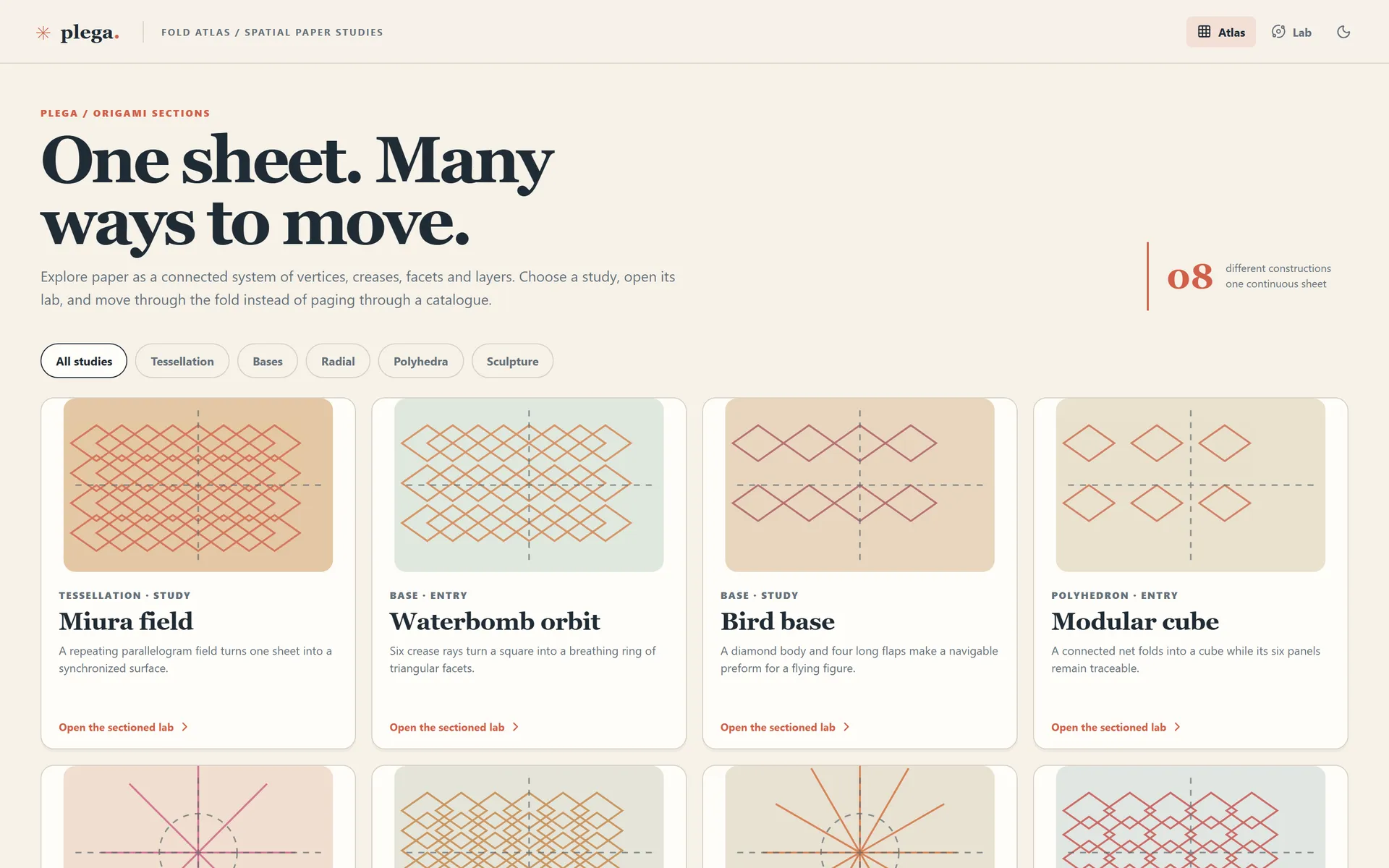
Plega, a Rigid-Paper Mechanism Workshop from Editable Design to Actual-Size Cut Files
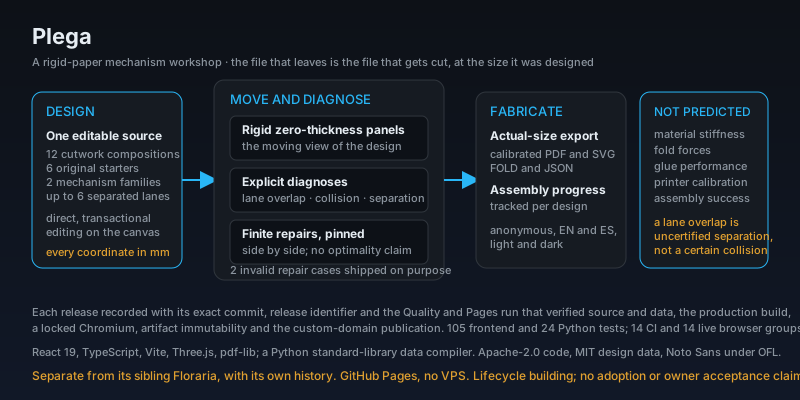
A paper-mechanism workshop that connects an original editable design to a moving rigid-paper view, explicit geometric diagnoses, pinned repair comparisons, actual-size vector export and assembly progress. Two restricted mechanism families, up to six separated lanes, six original starters and two deliberately invalid repair cases; every physical coordinate in millimetres; calibrated PDF, SVG, FOLD and JSON export; twelve editable cutwork compositions with transactional direct editing on the canvas. The model is rigid zero-thickness panels: it does not predict material stiffness, fold forces, glue performance or printer calibration, a lane-bound overlap means uncertified separation rather than a certain collision, and finite repair proposals do not claim global optimality. Lifecycle: building.
Business Context
For a maker, a teacher or a designer of pop-up work, the value is that the file that leaves the workshop is the file that gets cut, at the size it was designed, with the failures found before the paper is. The boundaries are the product's own words: the research model uses rigid zero-thickness panels; it does not predict material stiffness, fold forces, glue performance, printer calibration or physical assembly success; lane-bound overlap means uncertified separation, not necessarily a collision; finite repair proposals do not claim global optimality. Apache-2.0 code, MIT design data, the embedded Noto Sans under its OFL attribution.
Strategic Value
Plega grew out of the same rebuild discipline as its sibling Floraria and is kept separate from it, with its own history and deployment preserved. Each release is recorded with its exact main commit, release identifier and the Quality and Pages run that verified source and data, the production build, a locked Chromium, artifact immutability, the custom-domain binding and the publication: 0.01.000 on 2026-09-09, 0.02.000 with direct canvas editing, 0.05.000 as the current artifact. 105 frontend and 24 Python tests, 14 CI and 14 live browser groups. Not claimed, in writing: adoption, physical assembly certification, owner visual acceptance; the lifecycle stays building.
The Challenge
A paper mechanism is designed flat, judged in motion and fabricated at actual size, and the three usually live in three tools that do not agree: a drawing that cannot move, a rendering that cannot be cut, and a print whose millimetres drifted somewhere in between. A workshop that keeps one editable design as the source, moves it as rigid panels, diagnoses what breaks (lanes that overlap, panels that collide, pins that will not hold) and exports the cut file at the size the printer will honour has to be honest about what a zero-thickness model can and cannot say about real paper.
Our Approach
One editable design, twelve cutwork compositions and six original starters over two restricted mechanism families and up to six separated lanes, edited directly and transactionally on the canvas with valid creation, recovery and fabrication. The rigid-paper view moves the design as zero-thickness panels; geometric diagnoses are explicit (overlap within a lane, collision, separation); repair proposals are finite, pinned and compared side by side against the original; assembly progress is tracked; export is calibrated PDF and SVG at actual size, plus FOLD and JSON, with every physical coordinate in millimetres. The stack is React 19, TypeScript, Vite, Three.js and pdf-lib with a locked Playwright, and a Python standard-library data compiler; both languages and themes; anonymous use with no account. Two invalid repair cases are shipped on purpose so the diagnoses can be seen failing correctly.
Key Performance Indicators
| KPI | Baseline | Result | Impact |
|---|---|---|---|
| Design, motion and cut file agree | Three tools, three copies, millimetres lost between them | One editable design moved as rigid panels, diagnosed, repaired with pinned comparisons and exported at actual size in PDF, SVG, FOLD and JSON | The failure is found before the paper is cut |
| Diagnoses that can be seen failing | A checker that only shows successes | Two deliberately invalid repair cases ship with the six valid starters; overlap, collision and separation are reported as what they are | A lane-bound overlap is uncertified separation, not a claimed collision |
| A model that states its limits | A render presented as a fabrication guarantee | Rigid zero-thickness panels; no stiffness, fold force, glue, printer calibration or assembly success predicted; finite repairs without a global-optimality claim | The physical build stays the maker's responsibility, and the site says so |
Architecture
plega pipeline
Technology Stack
Application Screenshots